Home
Parent Page
J.M.W. Turner
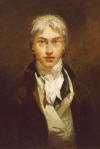
Self portrait, age 24
The son of a barber and wig maker in Covent Garden, Joseph Mallord
William Turner was born in London in 1775. As a child, Turner made money by
colouring engravings for his father's customers. At the age of 14 he entered the
Royal Academy. He exhibited his first drawing,
"A View of the
Archbishop's Palace in Lambeth" in 1790. Two years later he was providing
illustrations for the Copperplate Magazine and the Pocket Magazine.
In 1792 Turner went on his first sketching tour. Most of his pictures during this period
were cathedrals, abbeys, bridges and towns but in 1796 he became interested in painting
pictures of the sea. He also began touring with his artist friend, Thomas Girton.
By 1800 Turner was acknowledged as one of Britain's leading topographical watercolourists.
He received several commissions to illustrate books. His artistic ability was
recognized when he was elected an associate of the Royal Academy.
In 1803 Turner's style changed. His impressionistic Calais Pier was criticized as being
unfinished. For the next few years he was attacked by the critics and he had difficulty
selling his paintings. One critic called Turner's landscapes "pictures of nothing,
and very alike." Turner had his supporters, including John Ruskin, who
described his paintings as "true, beautiful and intellectual".
In 1844 Turner turned his attention to railways and painted Rain, Steam and Speed The
Great Western Railway. J. M. W. Turner died at his cottage in Chelsea in 1851. He left his
paintings drawings and sketches to the nation.
Some personal anecdotes regarding Turner by Frederick Goodall
When Fred Goodall was a boy, Turner was a constant visitor to the house and was a
family friend and business associate all his life. Fred described Turner
as follows: "Turner was a little under middle height, about five feet five
inches, rather heavily built, with large head, and bright, clear complexion when I first
saw him, though it became more highly coloured in later life; his nose was well shaped,
and approaching to aquiline; his eyes were piercingly bright, grey in colour, with a
trace of blue. His manner of speaking was slightly abrupt, but he had a very , very
pleasant smile occasionally, when speaking to any one whom he liked. I should say
that he was a self educated man, but most learned in his knowledge of the laws and
appearances of nature in all aspects. Turner was supposed to be niggardly, but I can
safely say that he showed the greatest kindness and generosity to my father. Although he
was not handsome, he had a most intelligent looking face. In very cold weather
Turner used to put a silk handkerchief over his head and then his hat, to keep off the
draught. Landseer was so amused at his appearance that he painted a back view of
Turner on his palette, which was considered so marvelously like him that the members
begged him not to clean the palette off. His old father used to wear his left off
hats but as Turner had a very large head and his father a very small one, the latter
was always obliged to put a handkerchief in front under the hat lining to make it fit.
The press of the day was not at all generous to Turner. I remember
reading when I was very young that "Turner had sent in another mustard
pot." Another critic felt that the hanging committee must have hung Turner's
picture upside down, for he could make nothing of it - which was probably true.
Turner lost a picture one day and asked his friend Mr. Graves to suggest a way of finding
it. Mr. Graves took a sheet of note-paper out of a desk drawer and said, "You
had better make a sketch of the missing subject, so that I may know it it turns
up." He made the drawing, and when it was done with, Mr. Graves scrambled it
into a drawer. "No!" Turner exclaimed, "you are not going to run away
with my drawing like that; it will fetch something some day," and took it back and
put it in his pocket. One final note is that a sum approaching 100,000 pounds was
set aside out of Turner's will to provide annuities of 50 pounds each for about 12
impoverished artists."